
Hark! What is that dreadful tapping,
As of someone gently rapping, rapping at my chamber door?
Ah! A visitor. I might have guessed as much. Please, do come in.
I’m so pleased you’ve found your way through brush and bramble to our little paper. Your presence here means a great deal—we deeply appreciate your patronage in all its forms, and we—I, especially—hope you’ll find something within our many pages to both terrify and delight.
But, I can hear you asking with deep trepidation, who, exactly, am I?
I could provide many answers that might satiate your curiosity (though only some of them would be correct), but for concision’s sake—about which I am usually unconcerned—and the sake of your precious time, I will adhere strictly to the facts.
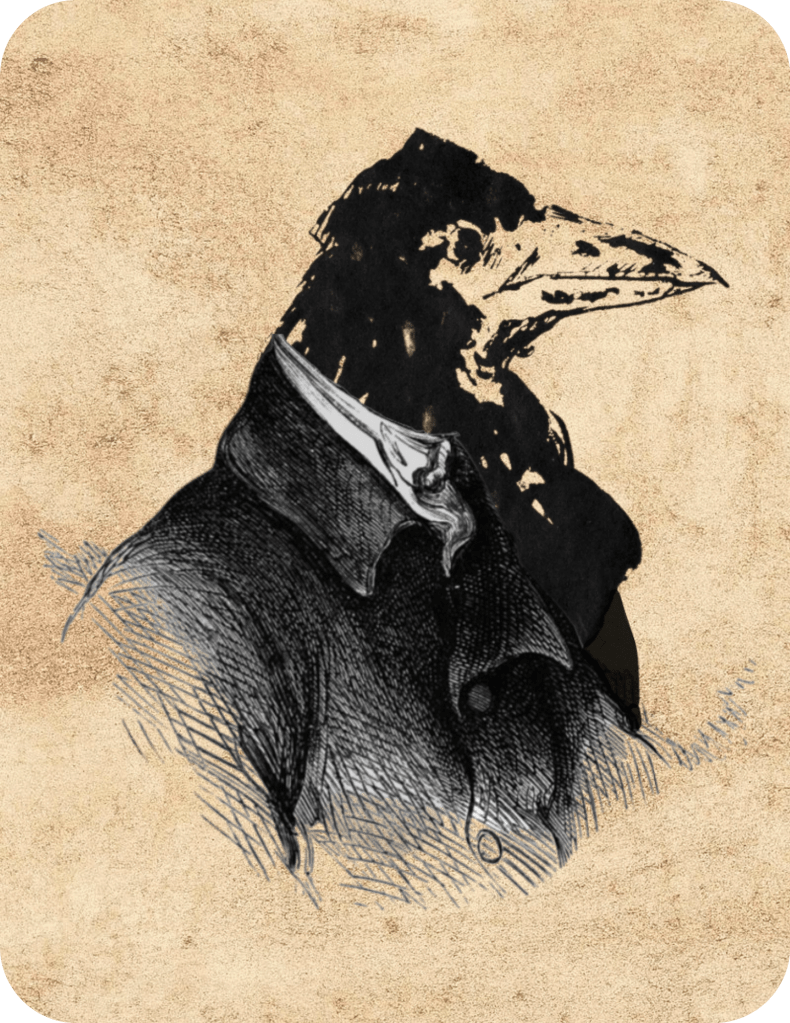
Primarily, I am the proud Editor-in-Chief of this singularly superb publication. I am a teller of tales, a collector of literary curios, and a denizen of all matters dark and dismal. I am also, as you may have noticed, a raven, and a quite infamous one, at that.
Yes, while I am primarily The Raven Post’s Editor-in-Chief, I am secondarily the eponymous “Raven” from a certain E.A. Poe’s best-known scribbling. It’s a title I hold with great pride, though, for the sake of my dignity and professional efforts, I discuss it only on the most infrequent occasions.
Shall I indulge your fascination and share clandestine details of my relationship with the notorious scribe? Unfortunately, even if I wished to, I could not tell you much of substance; we were little more than acquaintances, all things told, and in fact, I hardly knew he was cataloging anything of our brief interactions until the poem appeared in The New York Evening Mirror for the world to see!—or, if not the world, the streets of New York, which, as anyone hailing from New York will tell you, are of the most significant sort. The damned poem became so instantaneously popular, children and passersby would even quote its verses to him in the street! I wasn’t present for this, of course—he relayed this to me some time later, and I dare say it made him positively giddy.
I don’t begrudge him the fame he garnered from its publishing, merely the limited cultural understanding of ravens the general public shortly developed as a result. The number of times I’ve been entrenched in private business, attempting to discuss some pressing matter with a colleague or fulfill some already-late deadline, only for some witless onlooker to interrupt my efforts with another amateurish squawking of that infernal “Nevermore!”—why, the integer is higher than I, a raven of no inconsiderable education, can count! For better or worse, at the purloined cost of ravens’ dignity the world over, Poe afforded us a lifetime of infamy and secondhand acclaim. Even I must admit, I suppose, that it is a damned good poem.
But you must pardon my distraction—back to the matter at hand (or, rather, wing).
I began my career as a sort of companion and apprentice to another literary figure, a Mr. C. Dickens, if you’ll believe it. With the help of his great tutelage, I developed my love for words and storytelling, in particular a fascination with the Gothic and macabre. It was through these means I was introduced to Mr. Poe, for Dickens, himself inspired to adapt my personage—ravenage, perhaps?—into the realm of fiction, delivered to Poe a draft of his volume Barnaby Rudge. In response, the author’s only critique (at least to my own humble recollection) was that the story would be greatly improved if Dickens would only grant the fictional raven a much more significant role.
Poe and I became amicably connected following this exchange, and even after he published the infamous poem of which I am the hailed figurehead, we continued to explore in our own ways the delights and terrors of Gothic fiction, both of us intent upon honing our literary craft to perfection. While I shan’t bore you with the details of my own creative journey (we might be here an hour or more), I will say that during this period of several years, Poe wrote some of his most acclaimed work, notably “The Cask of Amontillado,” a hauntingly gruesome account that, to this day, sends a shiver down through my very tail feathers!
Tragically, this period ended with his shocking and untimely death in 1849; I myself am still unsure what exactly took place in those few fateful days preceding his demise, but needless to say, Dickens and I were jointly shaken. For some time, we both grieved and pondered this horrific twist of fate, and following my loyal Dickens’s passing 21 years later, I began carrying this mantle alone.
It was in Poe’s honor that I initially founded The Raven Post, and it is my ongoing privilege to continue my duties as its affectionate Editor-in-Chief. Poe, practically a pauper most of his life, deserved to receive the adulation he is now afforded while still a living man, but as we are presently separated by that great ethereal veil, perhaps cataloging his masterful tales—and encouraging others to follow in his authorial footsteps—will suffice.
My own affinity for the gruesome and spectral has come in great handy while paving my professional path these many years, and I can only hope I have made some small impact on the ancient mode of storytelling we avid readers and writers of the macabre so adore; above all else, I hope The Raven Post—my undying pride and joy—will only continue to grow, and I’m honored to shepherd you upon this journey into the most treacherous depths of fiction. Please enjoy my little library here at the intersection of past and present; stay as long as you like, and I wish you happy, haunted reading.
Warmest regards,
Your humble Editor-in-Chief
 The Raven Post